
If you bought or refinanced your Round Rock home back when rates were around 3%, and now you’re thinking about moving, you’ve probably had this thought:
“Why sell? I’ll rent it out, keep my low rate, and let the tenant pay the mortgage.”
Sometimes that’s a smart move. Sometimes it’s a slow leak that costs you money every single month, and you don’t notice until the first big repair bill shows up.
By the end of this post, you’ll have a simple way to run the numbers on your own home. I’ll also show you the three things most first-time landlords forget to count.
By the way, my name is April Aguren. I’m a Round Rock and North Austin Realtor®, and every week people reach out to me for help with their next move. If you’d like a private conversation about your next move, and how to avoid the costly mistakes so you make the right decision, book a free 15-minute call with me. No pressure, no pitch. Just a conversation about your next move.
Two things are pushing this question: rates and rents.
First, rates. The average 30-year mortgage rate was 7.32% the week of October 22, 2026 (Freddie Mac). A year earlier, it was 6.19%. If your loan is from a few years back, your rate might start with a 3.
So if you sell, you give up that low rate, and your next loan costs a lot more. That’s a real thing to lose. I get it.
Second, rents. People see the rent numbers and think, “I could cover my whole payment.” Here’s what the rent picture looked like in Williamson County in September 2026 (Unlock MLS):
What does that mean for you? Rents aren’t climbing fast, so don’t plan on raising the rent every year. But renters also have fewer homes to pick from, so a clean, well-priced rental should find a tenant.
That’s the good news. Now let’s do the math, because that’s where most people get surprised.
I bought my first investment property in 2005, with more determination than experience. I made plenty of mistakes: deals that didn’t pencil out, late-night maintenance calls, lessons I had to learn the hard way. I’ve been building and managing my own rentals for more than 20 years now. So this isn’t theory. It’s the same worksheet I use for my own properties.
Let’s use round numbers. These are an example, not your home. Your numbers will be different, and that’s the whole point of running them.
| Line | Per month | What it covers |
|---|---|---|
| Money coming in | ||
| Rent | $2,100 | The Williamson County middle rent (Unlock MLS, September 2026) |
| Money going out | ||
| Mortgage (loan part only) | $1,300 | A loan at around 3% |
| Property taxes | $650 | This one goes up when you move out (more below) |
| Landlord insurance | $150 | Not your regular home policy |
| HOA dues | $50 | If your home has them |
| Repairs | $300 | About 1% of a $384,000 home each year |
| Empty months | $175 | One empty month a year, spread out |
| Property manager | $200 | Often 8% to 10% of the rent |
| Total going out | $2,825 | |
| Short each month | $725 | About $525 if you manage it yourself |
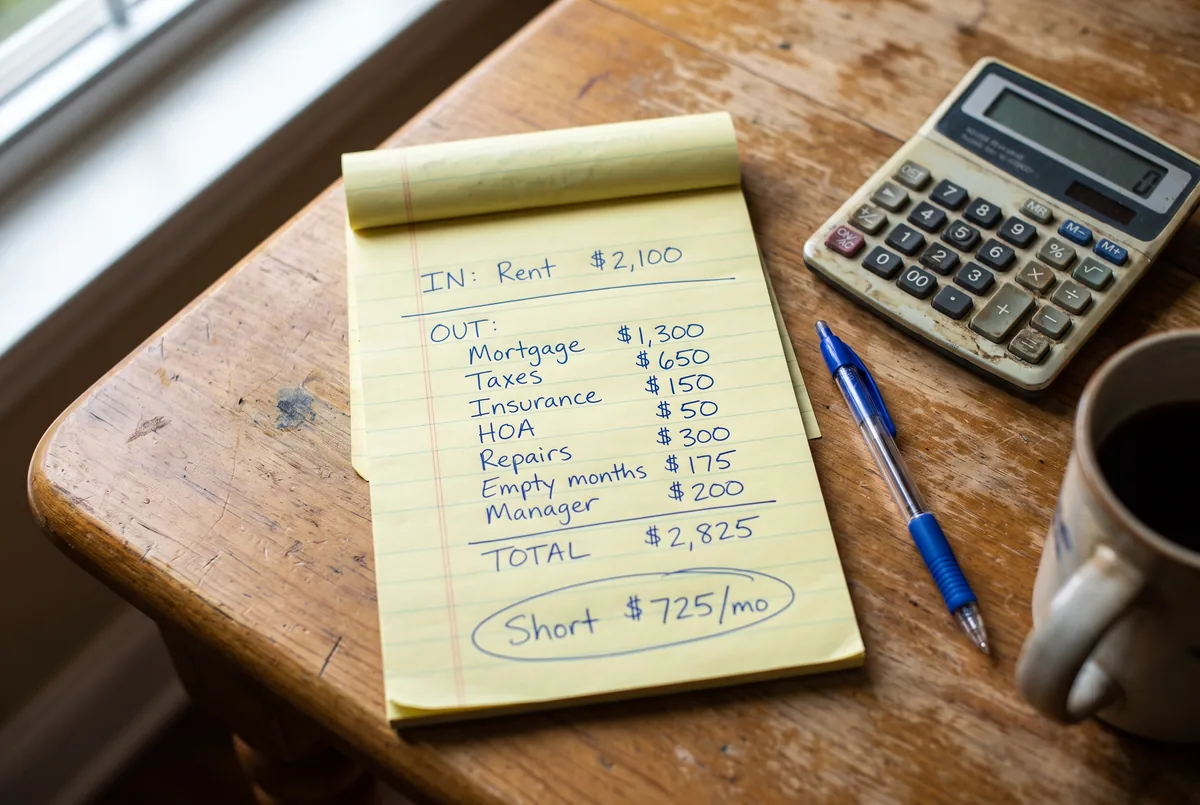
The repair line is the one people skip. Things break: a water heater, an AC unit in August. Many investors set aside about 1% of the home’s value each year. On a home around $384,000, the Round Rock median sale price (Redfin, August 2026), that’s about $300 a month.
Empty months get skipped too. Between tenants, the house sits empty while you clean, paint, and show it.
Add it all up and you’re about $725 short. Every month.
Being $725 short doesn’t make it a bad deal. Here’s the part a lot of people miss.
Part of every mortgage payment pays down your loan. On a 3% loan, more of each payment goes to paying down what you owe. In our example, about $600 a month goes toward the loan.
That’s not cash in your pocket. But it is money you get back when you sell. Think of it like a piggy bank you can’t open yet. Once you count the loan paydown, this example comes out about even.
That’s the slow, unglamorous work of growing equity. The real question is this: can you cover the gap every month, and for how long? Some people are fine putting in money each month and waiting years to get it back. Some people need that cash now. There’s no wrong answer. Just pick on purpose, not by accident.
In Texas, the home you live in gets a homestead exemption. It takes a big chunk of your home’s value off your school taxes: $140,000 right now, after Texas voters approved the increase in November 2025.
But a homestead is the home you live in. When your home becomes a rental, the exemption goes away, and your tax bill gets bigger.
Before you decide, call your appraisal district. For most of us here, that’s the Williamson Central Appraisal District. Ask what your taxes would be without the homestead.
When you sell the home you live in, a federal tax rule can let you keep a lot of your profit tax-free: up to $250,000 if you’re single, or $500,000 if you’re married (IRS home-sale rule).
To get it, you need to have owned the home and lived in it for at least two of the last five years before you sell. So if you move out and rent it, you have about three years to sell and still get that break. After that, the clock runs out.
There’s one more piece. While it’s a rental, you take a tax deduction called depreciation. When you sell, you pay some of that back, and the home-sale break doesn’t cover that part.
I’m not a CPA, and this isn’t tax advice. Please sit down with your tax advisor before you move out. That one conversation can save you a lot.
Some HOAs have rules about renting: how long a lease has to be, or registering your tenant. I sat on the Avery Ranch HOA board for 12 years. In Avery Ranch, for example, a lease has to run at least six months. Read your HOA rules before you sign a lease, not after.
Then there’s your time. Being a landlord means screening tenants, writing a solid lease, and answering the phone when the AC quits on a Saturday night. If that sounds fine to you, great. If it sounds like a second job you don’t want, count that too. A property manager can take a lot of that off your plate, but it usually costs 8% to 10% of the rent each month.

Let’s make this simple.
Renting it out may make sense if:
Selling may make sense if:
One more thing: don’t decide on a guess. Run your real numbers. That means your real loan payment, your real tax bill without the homestead, and real insurance quotes. That’s when the answer gets clear.
Here’s a simple homework list. You can do all of it in one afternoon.
Put those last two next to each other: rent on one side, sale on the other. That’s the moment it stops being a guess.
Renting out your home isn’t free money, and it isn’t a mistake. It’s a business decision. You can make it with less stress and more clarity once you see your own numbers on paper.
If you want a second set of eyes on it, that’s what I’m here for. Book a free 15-minute call with me, or call or text 737-234-9528. We’ll look at your home, what it might rent for, and what it might sell for, side by side. I’ll pull the rent and sale numbers for your street. No pressure, no pitch.
April Aguren • Realtor® • TREC License SA848552 • Hoyden Homes
Texas Real Estate Commission Information About Brokerage Services | Texas Real Estate Commission Consumer Protection Notice
Book a free 15-minute consultation, no pressure, no obligation.